
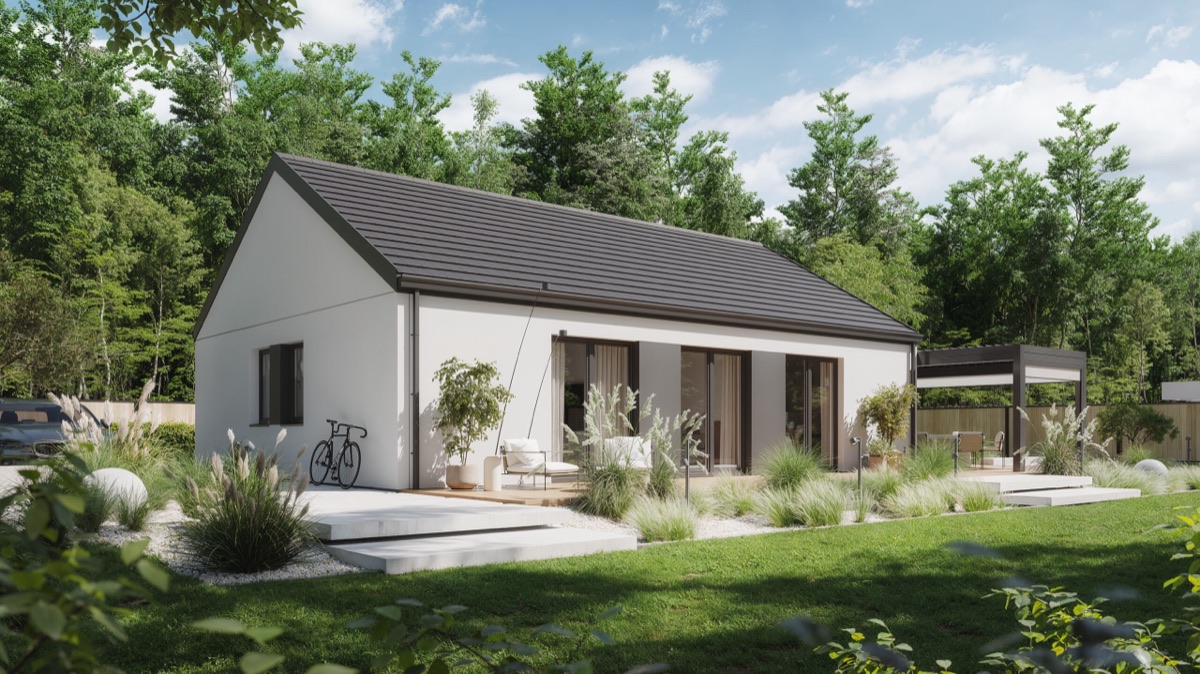
Modern concrete prefabrication is the result of engineering, research and advanced production under controlled conditions – it has nothing to do with the large-panel (“wielka płyta”) system from the communist era. The concrete MABUDO uses meets strict strength and weather-resistance standards, and its durability is measured in generations. We debunk the five most common myths.
Myth 1: A concrete prefabricate is a communist-era large panel
MABUDO concrete prefabrication is a completely different league from the technologies of decades past. Where quantity and speed used to be the priority, today durability, airtightness, resistance and consistent quality come first. Every prefabricate is made under the strictly controlled conditions of the plant in Zduńska Wola, with millimetre precision and constant supervision. The result: investors get a structure that meets standards for precision, thermal insulation, acoustics and load-bearing capacity. It's not “large panel” – it's large precision.
Myth 2: Internal insulation in the MABUDO ECO system is a mistake
Internal insulation in the MABUDO ECO wall stirs up strong opinions – investors ask about thermal bridges, moisture and thermal comfort. In reality it's a carefully engineered system in which every element serves a specific function. The components used carry quality certificates (TEZUS, TÜV, BBC), and the wall was developed on the back of years of experience from Sweden; its performance is confirmed by analysis carried out with the Krakow University of Technology, including finite element method (FEM) simulations.
This isn't “internal insulation” in the classic sense, but an advanced layered partition 36.25 cm thick, in which the thermal insulation, the load-bearing structure and the plasterboard grid form a coherent system with a U-value of 0.147 W/m²K. The whole assembly is designed to eliminate the risk of a dew point inside the partition. ECO also brings an impact-resistant facade (durable reinforced concrete), freedom to run electrical wiring before fit-out, and an open-plan interior. MABUDO offers three wall variants:
| Wall | Construction | Thickness | U [W/m²K] |
|---|---|---|---|
| MABUDO Classic | External insulation: render + insulation + reinforced concrete | 32 cm | 0.16 |
| MABUDO Eco | Layered, internal insulation + plasterboard grid | 36.25 cm | 0.147 |
| MABUDO Robust | Three-layer: reinforced concrete + insulation + reinforced concrete | ~32–40 cm | 0.14–0.23 |
Wall layers: L-shaped concrete, 5 + 18 cm graphite EPS, timber battens, vapour barrier and plasterboard.
Every wall technology comes with a 30-year warranty, and MABUDO's advisors and designers help you choose the best variant.
Myth 3: Prefabricated houses aren't durable
A concrete prefabricate is today the most durable available house-building technology – resistant to moisture, fire, frost and time, and with precise workmanship its durability is measured in generations. The reinforced concrete used in MABUDO prefabrication is designed to the relevant weather-exposure classes. The house keeps its airtightness, insulation and load-bearing capacity over the following decades, without costly renovations or having to replace the insulation after just a few years.
Like any building, it needs periodic inspection of the joints and occasional resealing (e.g. with a Sikaflex-type sealant) and repainting. With the ECO or Robust wall, the prefabricate's outer layer serves as the finish itself – there's no render that can crack or peel off; it's a monolithic, reinforced-concrete surface resistant to mechanical damage.
Myth 4: Building with prefabricates isn't actually fast
In reality, concrete prefabrication is one of the fastest and most predictable building methods – you measure progress not in years, but in months. If you choose one of the ready-made MABUDO designs, it's 3–6 months from your decision to picking up the keys, depending on the scope you choose.
Why? Most of the work happens in the factory and doesn't depend on the weather, assembly doesn't require technological breaks, everything follows a predictable schedule, and the elements are matched already at the design stage, which keeps adjustments and on-site cutting to a minimum. MABUDO has been building this way for more than 35 years – with precise workmanship, consistent quality and minimal waste.
Myth 5: Only a brick house is a “real” house
The belief that a house's durability and value depend on whether it was laid brick by brick is one of the most deeply rooted myths in Polish construction. Reinforced-concrete prefabrication gives you greater structural coherence, a smaller margin for error, and far more control over quality and time. Wall elements, floor slabs and lintels are made in a single process, in the factory, with a precision unattainable when bricklaying on site – there's no room for an “ill-fitting brick” or “frost that caught the concrete before it set”.
Prefabricated houses have better airtightness and insulation, don't crack from settlement (the joints are engineered as a system), don't depend on a bricklayer's “good hand” or the weather, and are more predictable to live in. MABUDO buildings are built to WT2021 standards and beyond, delivering a better energy balance than traditional buildings – lower winter bills, lower cooling energy use in summer, and real savings over the years.
FAQ – modern concrete prefabrication vs large-panel blocks: myths and facts
Is concrete prefabrication the same as “wielka płyta” (large-panel building)?
No. Modern prefabrication has nothing to do with the communist-era technology. Today's concrete prefabricates are made under controlled conditions, with the highest precision, and in line with current building standards.
Is a concrete prefab house durable?
Yes. The concrete MABUDO uses meets durability standards for exposure to fire, moisture and frost. Prefabricated structures remain durable for decades and don't need frequent renovation or insulation replacement.
Is internal insulation in the MABUDO ECO system a good solution?
Yes, when it's an engineered system like MABUDO ECO. It's not classic “internal insulation”, but a complex wall layer with precise insulation, confirmed by analysis carried out with the Krakow University of Technology (finite element method, FEM).
How long does it take to build a prefabricated house?
As little as a few months – depending on the chosen design and the scope of cooperation. Thanks to factory production and efficient assembly logistics, the process is far faster and more predictable than traditional construction.
Can a prefabricated concrete house be adapted to individual needs?
Yes. MABUDO offers several wall variants – Eco, Classic and Robust – plus flexibility in interior design. A technical advisor can help you match the right solutions.
Is a prefabricated house warm and energy-efficient?
Absolutely. MABUDO wall U-values reach as low as 0.14 W/m²K. Thanks to airtight partitions and continuous insulation, prefabricated houses have an excellent energy balance and low running costs.
What are the advantages of MABUDO prefab houses over brick-built ones?
Better quality control and workmanship precision, faster build time, less weather impact on the schedule, higher acoustic and thermal insulation, durability for generations, and less waste with a tidier building site.