
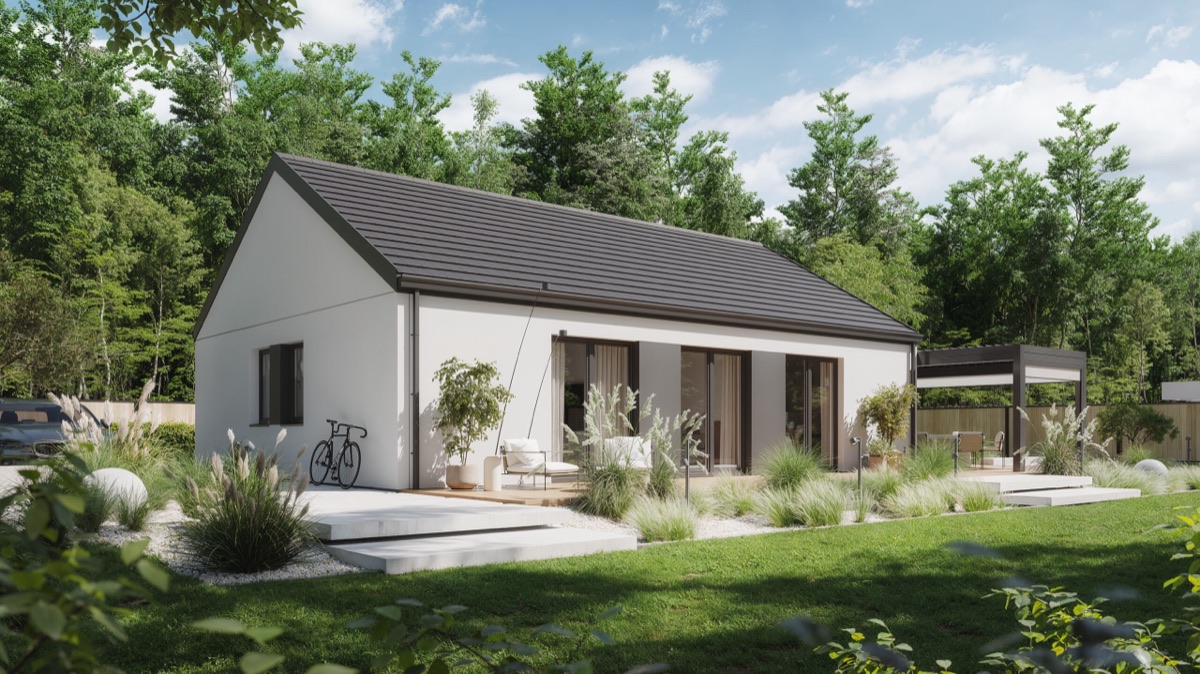
A house of the future isn't just an app on your phone
A smart home is most often associated with controlling lights, heating or blinds from a smartphone. That's only the visible part of the whole system, though. Behind every such feature are installations, cables, power supply, mounting points and decisions made before construction even begins.
If monitoring only enters the plan after the façade is finished, you'll need to find a way to route the cables afterward. If recessed blinds are chosen after the windows have already been ordered, extra work may be required. The same goes for an energy storage battery, an EV charger or an advanced energy-management system.
Each of these solutions needs proper preparation. Not everything has to be installed right away – in many cases it's enough to plan for certain solutions at the design stage, so the option to expand later stays open.
Why does concrete prefabrication help plan future installations?
One of the biggest differences between prefabrication and traditional construction is the moment at which decisions get made. In traditional building, some solutions are still worked out during the build itself. Prefabrication requires greater precision earlier on, because the process follows a fixed sequence: design → construction documentation → production → assembly.
That means many questions about installations have to be settled earlier. This approach demands more engagement at the start of the investment, but it limits the number of changes made during the build itself. So the conversation about monitoring, blind automation, alarm systems or energy management happens much sooner.
What does Smart Home look like in MABUDO technology?
In MABUDO technology, installation sleeves are made individually based on the design documentation and the site development plan – their location follows from the design prepared before prefabricated-element production begins.
It's similar with wiring inside MABUDO ECO® walls: cables are run through conduits before the plasterboard is mounted. That means the installation layout is known in advance and can be accounted for at the construction-documentation stage. This applies, among others, to:
- monitoring,
- alarm systems,
- video intercoms,
- heating control,
- electric blinds and shutters,
- energy-management solutions.
MABUDO ECO® and ROBUST® – why the conversation about installations should happen earlier
Not every prefabricated wall works the same way. In MABUDO ECO® technology, installations run through conduits before the plasterboard is mounted. It's different in MABUDO ROBUST® walls – here, most installations need to be planned before the elements even go into production.
Later changes are possible, but they may require intervening in finished elements and can leave visible traces of the work. That's why automation, monitoring or future installations are best discussed at the start of the design process – the earlier the routing of installations is decided, the more freedom remains at later stages.
Wall layers: L-shaped concrete, 5 + 18 cm graphite EPS, timber battens, vapour barrier and plasterboard.
Recessed blinds – a feature that shows how much the design matters
Recessed blinds or shutters are a good example of a solution worth planning well in advance. Fitting them onto a finished building can mean extra work and aesthetic compromises. In MABUDO technology they can be accounted for while the house is still being designed – this makes it possible to prepare the wall so the blind box is hidden within the window opening.
It's one of many examples showing that some decisions about everyday comfort are made far earlier than you might expect.
Which technologies are worth considering at the design stage?
There's no way to predict every solution that will appear on the market in ten or fifteen years. But a house can be prepared so that expanding it later doesn't require costly changes. Today, investors most often plan for solutions related to security, comfort and energy:
- Security: monitoring, alarm, video intercom, door and window opening sensors, flood sensors, smoke detectors.
- Comfort: external blinds, façade shutters, heating control, lighting control, automatic house scenarios.
- Energy: photovoltaics, energy storage, heat pump, energy-consumption monitoring system, EV charger.
Smart Home and energy
Building automation is no longer limited to controlling lights or blinds – a large share of new solutions now revolves around energy. A system can analyse power consumption, control heating, work together with a heat pump, or react to weather conditions. For example, it can adjust the temperature to the household's schedule, control the heat pump, manage blinds during heatwaves, analyse energy consumption, and work together with a photovoltaic installation and an energy storage battery.
A heat pump, photovoltaics, an energy storage battery and automation don't function independently of one another. The greatest potential appears when they've been treated as parts of a single energy-management system – the homeowner then has far more control over how energy is produced, stored and used.
The most common mistake? „We'll think about it later”
Many investors assume that installations can always be added after construction is finished. Technically this is often possible – the question is how much it will cost and how much work it will take. If monitoring only enters the plan after the façade is finished, a way has to be found to route the cables; if photovoltaics, an energy storage battery or an EV charger weren't planned for earlier, expanding later may require additional changes to the installations.
Some solutions can be added after construction – some devices work wirelessly. It's different with wired installations, recessed blinds, or solutions that require additional sleeves. In those cases, planning ahead helps limit the scope of later work.
Investor's checklist – what's worth discussing before construction
Answering a few questions helps determine which installations are worth including at the design stage:
A house ready for future technology starts with decisions made today
No one can predict what will be standard in ten or fifteen years. But it's safe to assume that buildings will become ever more closely tied to automation, energy management and integrated installations. That's why it's worth looking further ahead than just current needs during design.
In MABUDO technology, many decisions about installations are made before prefabricated-element production even begins – sleeves are prepared based on the design documentation, and the routing of installations in ECO® walls is known before the plasterboard is mounted. A house ready for future technology doesn't start with an app – it starts with a well-thought-out design.
FAQ – a future-ready precast concrete house: smart home, heat pump and solar panels
Does concrete prefabrication help prepare a house for smart home systems?
Yes. In concrete prefabrication, installation routes, openings and technical zones should be planned before production. This makes it easier to prepare the house for automation, blinds, heat recovery ventilation, a heat pump, photovoltaics and later smart home upgrades.
Which technologies are worth planning for a house in 2026?
It is worth discussing a heat pump, mechanical ventilation with heat recovery, photovoltaics, energy storage, concealed blinds, network cabling and building automation. Some decisions are best made before the prefabricated elements are produced.
Can smart home systems be added after the house is built?
Some solutions can be added later, but the cleanest and most comfortable result comes from planning them during the design stage, especially cable routes, technical space and elements hidden in walls or façades.
Why should concealed blinds be discussed early?
Concealed blinds affect lintels, insulation, façade details and wiring. In a prefabricated house they should be included before wall production to avoid later corrections on site.